
Semrush has become the most comprehensive SEO and marketing platform and the first SEO tool to introduce AEO/GEO tools to measure the performance of brands in AI models.
The platform has now become a subsidiary of Adobe on 28 April, 2026.
Here’s our honest review for buyers evaluating the Semrush platform for 2026.
As an SEO expert, I used Semrush One to grow my own blogs and improve their AI visibility across AI search results.
So, if you’re considering Semrush, you may be wondering if it’s really worth the investment.
I have been using the tool for the past 8 years for keyword research, backlink analysis, competitors’ analysis, site auditing, and improving my website ranking.
Now that the Semrush platform has evolved from traditional SEO into an all-in-one marketing suite, it combines an AI visibility toolkit.
TL; DR
Semrush is an all-in-one digital marketing and SEO platform built to provide insights on keyword research, site audit, competitor analysis, position tracking, backlink tracking, and paid advertising (PPC).
The platform has included AI visibility tools to track how brands and sites appear and perform in AI-generated responses across platforms like Google Gemini, ChatGPT, and Google AI Mode.
In this post, I’ll share how Semrush compares to other SEO tools and what makes it better.
Is Semrush Worth It In 2026?
Yes, Semrush is worth it if you’re looking for comprehensive SEO and AI visibility tools for organic results and tracking brand performance across AI search engines.
Growing Organic Traffic with Keyword Research
One of my biggest challenges is keyword research. Creating content without proper keyword research.
And my content never ranks on the first page of Google.
No content optimization, keyword difficulty score etc
With the Semrush Magic tool and keyword overview, I was able to uncover low-competition and high-intent keywords and focus on long-tail keywords with clear intent.
Here’s what I did:
- Find low-competition keywords with high intent
- Identify long-tail keywords that are easy to rank
- Analyze keyword difficulty and create well-optimized content around those keywords.
Competitor Analysis to Discover Hidden Opportunities
I like doing competitor analysis and research, and it has helped me uncover some hidden opportunities to grow and outperform my competitors.
With the Semrush tool, I can analyze competitor sites and uncover the exact keywords they were ranking for.
I like how the tool helps me discover content gaps and reverse-engineer their performing pages.
With this feature, I was able to create better optimized content and tap into the organic traffic I was missing.
Using Site Audit to Fix SEO Issues
Using the platform to audit a website has a great advantage.
I used the Semrush audit tool to identify technical SEO issues on my websites.
With its site audit, I was able to:
- Quickly identify and fix broken links and crawl errors
- Fix on-page SEO issues
- Improve site health and performance
- Optimize and improve overall site structure
Adapting to AI Search
With the rise in AI tools, data shows that many users are now moving to AI platforms to find answers to their questions.
Semrush is the first SEO tool that adapts AI search platforms like ChatGPT and Google Gemini.
With its AI visibility tool, I can research question-based keywords to know what people are searching for in my niche.
Optimizing content for AI to understand my page intent and clarity.
Tracking the performance and visibility of my website and going beyond traditional SEO.
With the AI visibility toolkit, I can position my content not just for Google but also for AI-generated search results.
By applying the right SEO strategies, Semrush is a powerful growth engine for anyone to grow their brand, not just mine.
Now that you understand how this SEO and AI tool has helped me increase my website’s traffic, let me give you more details about it.
What Is Semrush?
Semrush is an all-in-one marketing tool designed to increase organic traffic, improve AI visibility of your website, and outrank your competitors.
The Semrush core features offer real-time data and insights that show:
- What users are searching for
- Which low-competition keywords you can rank for
- How your competitors are performing
- Site audit to fix SEO issues on your site
- Which AI platforms are citing your site as a source?
- And how to increase your online presence
What Can You Do With Semrush?
Here are what you can do with it:
Perform Keyword Research – Identify easy-to-rank, profitable keywords with real search data.
Perform competitor analysis: See exactly how your competitors are performing.
Website Audit: Identify and fix SEO issues and crawl errors
Backlink Analysis: Identify competitors’ backlinks to build high-quality links.
Rank Tracking—Track your keyword positions on Google and other search engines.
Content Optimization: Create and optimize content that ranks faster.
PPC Research—Analyze paid ads and identify your competitors’ paid keywords.
AI Visibility Tracking—Optimize your content for AI search platforms and increase your brand visibility.
The Semrush Core Features & How I Used Them
Semrush has many features and combines different marketing tools into a single dashboard.
As a blogger, I work with SEO and content writing. Let me share with you some tasks that Semrush can help you do to improve your workflow.
Find keyword ideas based on primary keyword.
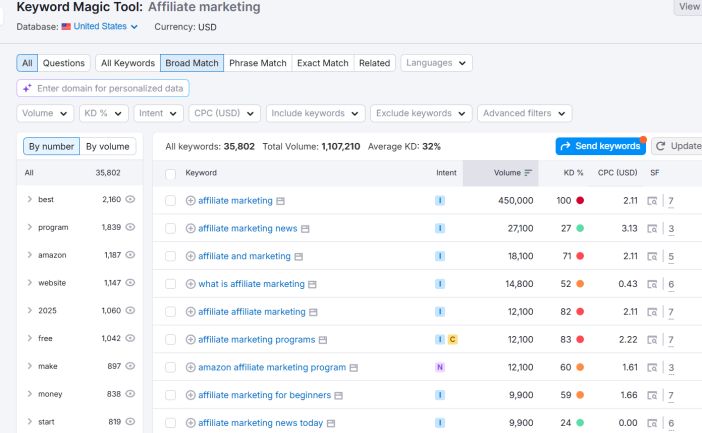
If you want to rank on search engines like Google, Bing, or even in AI search platforms, keyword research is where everything starts.
Semrush Keyword Magic Tool is simply the best among the SEO tools, and it can help you:
Identify low competition keywords you can easily rank for based on your seed keywords and find long-tail keywords with high intent.
Analyze keyword difficulty score, volume, and trends so you’re not wasting much time on keywords that can’t produce results.
Group all the related keywords by topic to help plan your content.
In my experience, I used the Magic tool more than other tools. It helped me stop guessing and targeting keywords that bring in consistent targeted traffic.
Here is how to use the Semrush Keyword Magic tool step by step.
Step 1: Head to the Keyword Magic tool. Once it opens, add your seed/primary keyword.
For example, my seed keyword is “Affiliate Marketing.”
Step 2: Indicate the metric to show relevant keywords, such as
- Volume 400
- Keyword Difficulty: Easy
- Search Intent: Commercial
With these metrics, you can quickly narrow down your search and identify related low-competition keywords that are easy to rank for your website.
Analyze Any Website
With the free plan or the Semrush Pro plan, you get access to the domain overview tool to check any website.
Semrush’s domain overview makes it easy to spy on your competitors.
Here is how the Domain Overview feature can be useful for you.
- See the current performance of your website
- Track your website’s organic traffic and keywords if they rank higher or go down
- See the keywords your competitors are ranking for
- Identify your top-performing pages or your competitors
- Know the traffic estimates of any website
- Find out where the website’s backlink sources are for link building
With this data and insight, you can reverse-engineer what’s working for competitors’ sites you analyze and apply it to your strategy.
Most SEO tools provide similar reports but come with lower metrics.
What I like about this feature is that it provides reports with insights to help uncover hidden keyword opportunities for website content.
Identify top-performing pages of your competitors
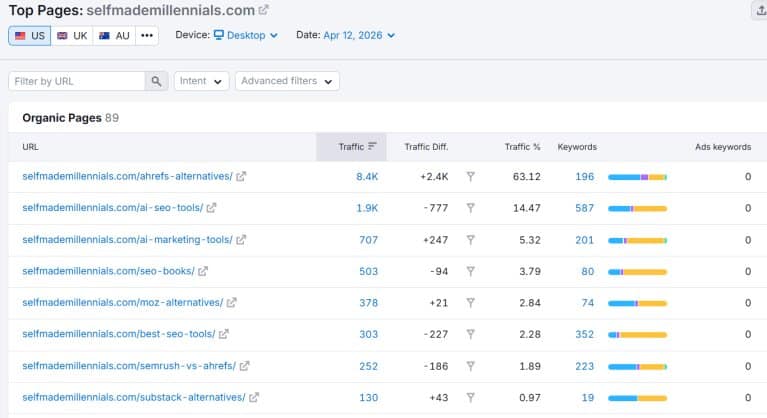
Another thing I like about the tool is how easy it is to check my competitors’ top-performing pages.
Whenever I get stuck on keyword research to find what to write, I look at some of my competitors’ pages that are performing well in terms of organic traffic.
I have been using this strategy for the past 8 years, and it works for me.
Go to the top page and filter by traffic, and you will see the top-performing pages.
Click on it, go through it, and find the content gap to outrank your competitors.
Uncover the Top Performance Keywords of Your Competitors
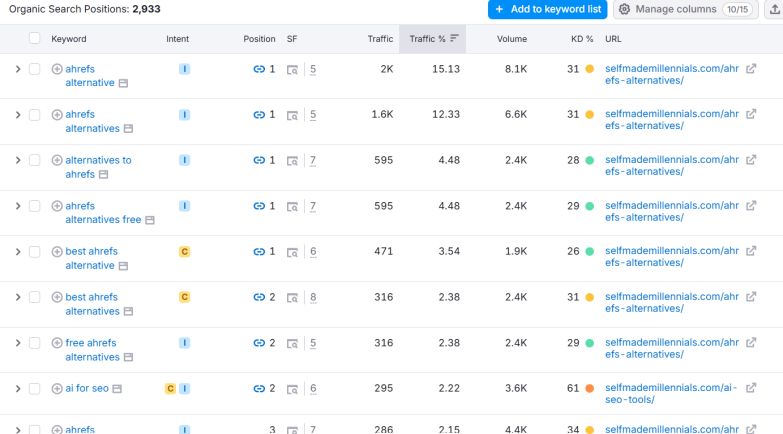
Another metric you may want to uncover is the competitors’ top keywords based on their performance.
This method will ease your work, as Semrush will show you the list of keywords that track your competitors’ most traffic.
From organic ranking to position, you will see top keywords, search intent, and their feature snippet.
Identify those with low competition and a long tail, and create well-optimized content around them.
Identify keywords your competitors rank, but you don’t
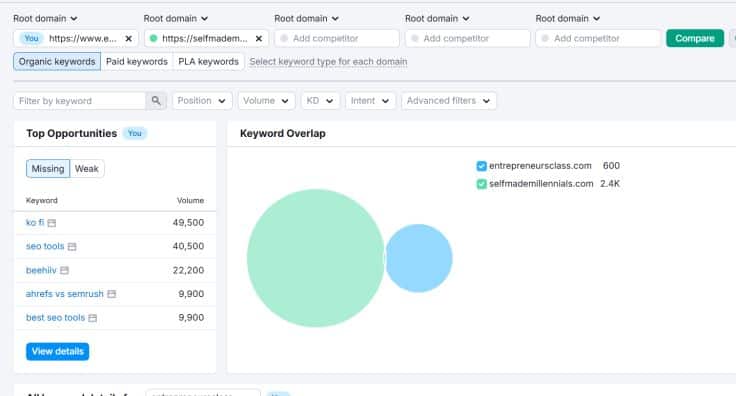
This is another keyword research strategy I use to compete and outperform my competitors.
With Semrush Keyword Gap, I can easily check those keywords that my competitors rank for, but I don’t.
It will help me update my content and re-optimize it for better ranking.
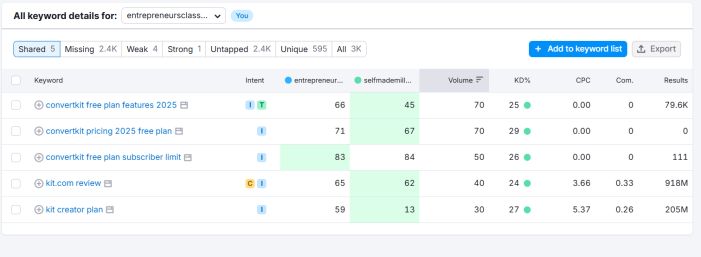
Here is how you can do it.
- Go to the Keyword Gap page
- Add competitor URLs
- Click compare and select untapped.
If you add direct competitor URLs, you will get tons of keyword ideas for your website.
Once you have the list of keywords your competitors rank for, and you’re missing out, go and update your content or write a well-optimized one with data and insights.
Audit website for technical SEO
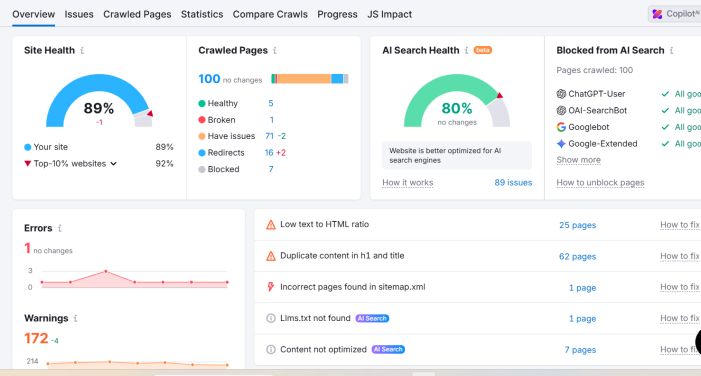
You can identify broken links, crawl errors, and how to fix them.
I use it often to check my website for any technical issues or competitor websites.
Technical SEO can have an impact on your rankings, and the Semrush audit tool makes it easy to fix.
The tool scans website pages and identifies issues like:
- Broken links
- Crawl errors
- 404 errors
- Non-index pages
- Slow-loading pages
- Missing meta tags
- Duplicate content
It also gives you a site health score and recommendations to fix them.
Here is how you can audit your website.
Step 1: Add your website to Semrush
On the right side, click on Site Audit.
You will see the site overview, issues, crawled pages, site health, etc.
Click on each of these to identify errors and get recommendations on how to fix them.
I used the site audit tool to clean up my websites and improve indexing and performance.
Although I have seen many websites with some technical issues that still rank in the top position on Google.
But it is advisable to always check your site for any technical SEO issues and fix them.
Get On-Page SEO Recommendations
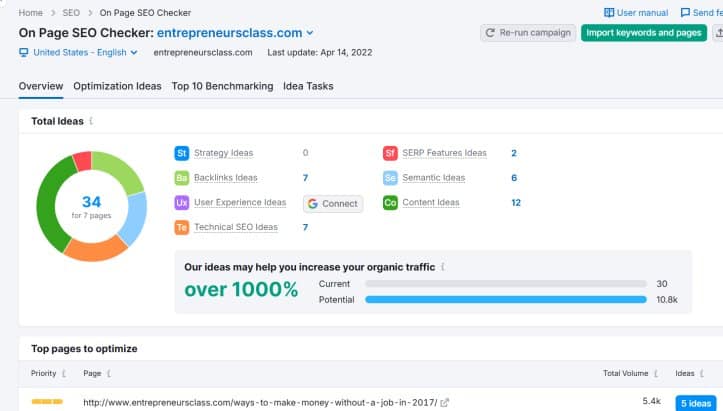
On-page SEO is very crucial if you want to rank on Google and other search engines.
The Semrush On-page SEO checker will scan your website and identify some technical issues and SEO mistakes that can impact your ranking.
What I like about this tool is that it gives recommendations and points out areas to improve your content, site structures, and fixes all the SEO issues to make sure your site ranks higher.
You will need to create a project on Semrush and add your website.
When I tried it, I got 34 suggestions for 6 pages on my website.
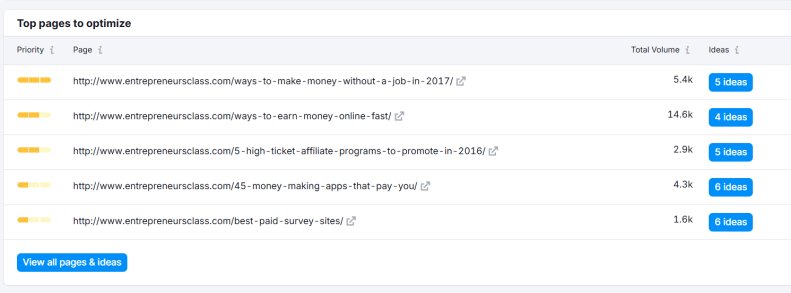
In my own case, I reviewed all the Semrush recommendations for my 45 money-making apps and implemented all the suggestions.
Here is what I did:
- I re-wrote the introduction
- Update up to 35% of the content
- Add a new FQAs section
- Include related keywords strategically
Semrush also suggests avoiding keyword stuffing and offers me some websites where I could get backlinks to compete with competitors.
And after a few weeks of updating the content based on Semrush recommendations, I see improvement in impressions and traffic.
I recommend updating and refreshing your content from time to time to get chance of ranking higher on search results.
Spy on Competitors’ Backlinks For Quality Links
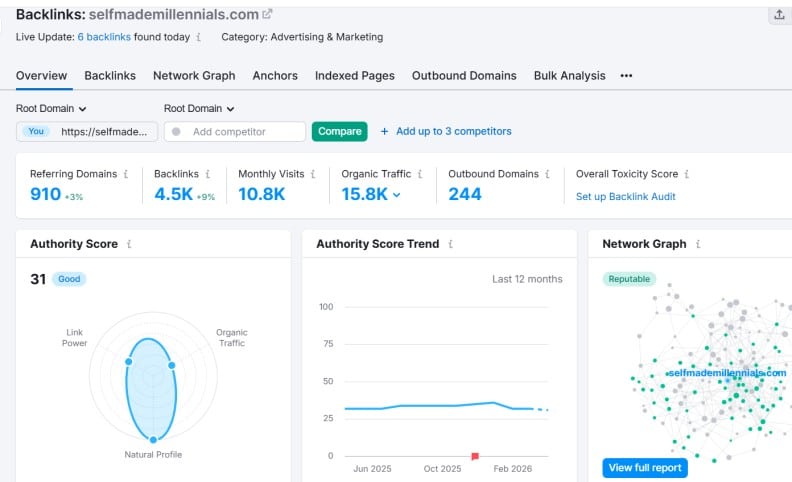
Backlinks are still a major Google ranking factor, and Semrush gives you powerful tools to spy on your competitors and steal their backlinks.
This is one of the features many SEO agencies use often to help build quality links that Google loves.
I use the backlinks tool to spy on my site’s competitors to know where they’re getting links that help them rank.
The Semrush backlinks tool helps to:
- Analyse your backlink profile
- Spy on competitors’ backlinks
- Identify link-building opportunities
- Track new and lost backlinks
To use this tool, click on backlinks and enter the competitor’s URL. It will show the domain overview, and click on the backlink.
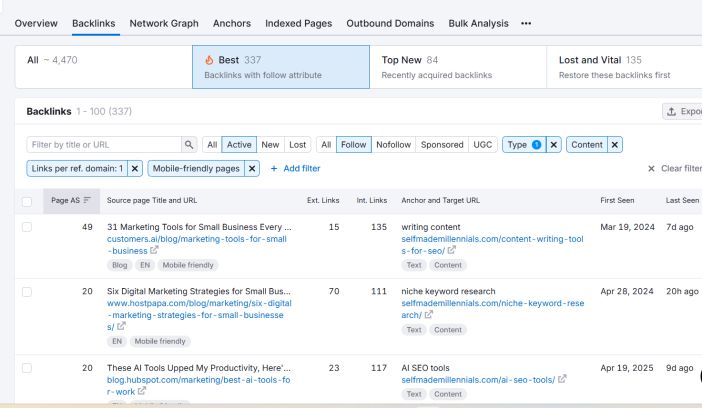
You will see all the websites that link to the domain.
Check all the links and copy those that look good, contact them, and see if you can get ink to your site.
This is a great way to build a stronger authority in your niche. I have used this method several times to attract quality links to my site and rank on the first page of Google results.
Monitor and Track Your Keywords Position
After spending hours working on your site SEO, it is essential to find out if your time and effort are working.
I check my site keywords’ position almost every week to know which keywords move up and which move down.
The keywords tracking tool lets you monitor your keyword rankings daily, weekly or monthly.
With the position tracking tool, you can track:
- Keyword positions on Google
- Ranking changes over time
- Mobile rankings
- Competitor performance
Tracking your position helps you to know which site page ranks at the top, which one moves down, so you can make necessary adjustments to improve their ranking.
In my experience using Semrush, position tracking is essential to measure your progress and adjust your SEO strategy.
Create Content That Ranks
Whether you’re a blogger or content creator, creating content doesn’t guarantee ranking on the first page of results.
You need to find content ideas and understand how to optimize them for SEO.
This is where the Semrush content toolkit comes in.
It provides data and insights to help you create content that ranks faster without requiring spending hours on link building.
Here is what I can do:
- Generate content ideas
- Optimise content for SEO
- Analyse content readability
- Avoid keyword stuffing
- Improve on-page SEO
This tool is useful if you’re creating blog posts and affiliate content often to grow your business.
Get Cited Across AI Platforms
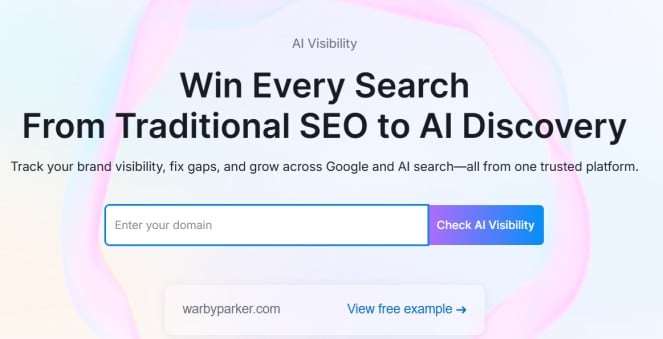
Many users are moving toward LLMs to find answers to their questions.
And according to the data, ChatGPT is getting over 600 million searches per week.
And Google AI overview is about to reach billions of searches per month.
If you’re not optimizing your content for AI, you’re losing to your competitors.
This is where Semrush is evolving, and many SEO tools are still catching up.
With the rise of AI search, such as Google Gemini, ChatGPT, Perplexity, Semrush is the first SEO tool to help you:
- Track AI-driven search trends
- Discover question-based queries
- Optimizing content for intent and clarity
Semrush AI visibility tool helps your brand stay visible not only on Google, but also in AI-generated responses and answers.
As a content creator, I like this feature, and it has been part of my system to optimize my content for AI.
Statistics show that AI traffic is getting more conversions than other traffic sources.
And if you want to improve your brand visibility across all AI search engines, the Semrush AI toolkit is the answer.
With the combination of traditional SEO and an AI visibility tool, SEMrush is now a complete SEO and marketing ecosystem.
Based on my experience using Semrush, these features matter most:
- Keyword research
- Competitor analysis
- Site audits
- Content optimization
- AI visibility
When you master these, you can drive consistent traffic and grow your business.
Semrush AI Features Update In 2026
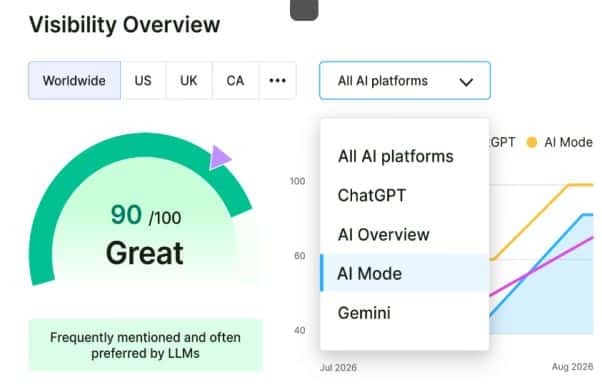
SEO is changing, and now it isn’t about ranking on Google alone; you need to show up across AI-powered search platforms like Perplexcity, Google AI overviews, and ChatGPT.
This is what makes Semrush go beyond traditional SEO tools and integrate an AI visibility tool to help track the performance of your site across all AI platforms.
How Semrush is Adapting to AI Search
Semrush is now combining traditional SEO and AI to help you:
- Understand search intent deeply
- Understand content optimization for conversational queries
- Track AI trends
- Ready for AI-generated search results.
In summary, it is evolving from keyword-based SEO to AI optimization and intent-driven.
I wrote a blog post on AI SEO, on how to improve your brand visibility in AI search engines.
Let’s dive into how Semrush can help you get mentioned and cite your site as a trusted source.
Understand AI Keyword Research
Unlike traditional keyword research that focuses on search volume, AI search focuses more on:
- Questions people are asking
- Context behind those queries
- Natural language phrasing
- Semrush One helps you discover
- Question-based keywords for AI answers and featured snippets
- Long-tail conversational queries
- Topic clusters
Get mentioned and cited as a source
For my site to get AI visibility, I started prioritizing question-style keywords.
And it has increased my chances of being featured in AI-generated answers.
If you want to get AI traffic, shift from using only traditional keywords to AI question-based queries or combined the two for more visibility.
With the Semrush One AI tool, you can uncover these keywords for your content.
Search Intent Analysis
One major Semrush strength is how it categorizes keywords by intent:
- Informational
- Navigational
- Commercial
- Transactional
In your content, it is crucial to help search engines and AI understand the intent.
Since AI platforms prioritize clear, intent-matching content, don’t write any content without optimizing for AI SEO.
In my latest content approach, I make sure:
I align every piece of content with a specific intent.
The results are outstanding with improvement in both rankings and engagement.
Content Optimization with AI
Just like optimizing for keywords, the AI assistant content optimization helps you to optimize your content and prepare it for AI search platforms.
It will help AI to understand your content and cite it as a source when generating responses.
The AI-Assisted content optimization tool helps to:
- Optimize content for readability and structure
- It helps AI to understand content and cite it
- Add relevant semantic keywords
- Analyzing top-ranking content and giving recommendations
- Improve your content clarity for AI extraction of the answers or responses
Using the Semrush AI assistant tool to optimize your content can increase your chances of being used as a source in AI-generated answers.
Optimizing My Site for AI Search
Everyone knows that AI search is trending now, and I was one of the content writers who took the early lead.
Here’s how I personally use Semrush One to adapt to AI search in 2026:
- I created content that focuses on clear and concise answers
- I target long-tail and question-based queries in my content
- I structure content that satisfies Answer Engine Optimization tools with proper headings and summaries
- Include data and insights from Semrush to validate topics
This approach has been helping my content perform well on Google and AI-driven platforms
As AI is reshaping how people search, Semrush is gradually adding features to support this shift.
While it’s not a complete AI SEO tool, it combines both traditional SEO and an AI tool and provides the data and insights you need to stay ahead.
If you run a WordPress website, you can use the GEO Optimizer plugin to optimize your content for AI search engines. Read the GEO Optimizer review to learn more.
New Semrush Pricing
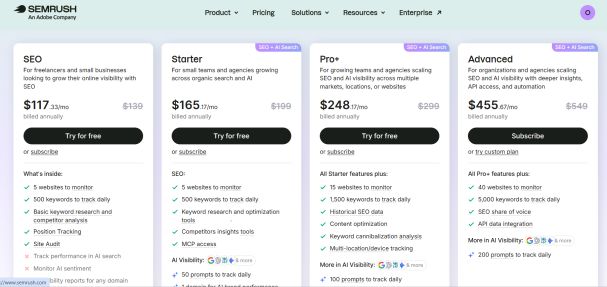
Semrush Pricing Plans Overview
Semrush has four pricing start fro, $139.95 per month for SEO plan and $117/month when billed annually.
Here ate the deyails of the Semrush Pricing plans:
Free Plan: The free plan allow you to text its features and see if it worth your money, but it comes with limited features.
SEO Plan
The SEO plan cost $139.95/month or $17/month billed annualy.
The Semrush SEO plan is a great starting point and best for bloggers, affiliate marketers, and small business owners.
With the pro plan, you get access to all the core features, like:
- Keyword research
- Competitor analysis
- Site audits
- Position tracking
If you’re a beginner or starting, this plan is enough to grow your site traffic.But the main disadvantage is that it soesn’t come with AI search.
Starter + AI Search AT $199/month
This plan is best for small teams and agencies growing thier organic search and AI.
It costs $199/month or $165/month billed annually.
It comes with SEO features plus:
- Monitor up to 5 websites
- Track 500 keywords per day
- Access to keyword research
- Optimization tools for SEO content
- Competitors insights tools
- Acces to MCP feature
- AI Visibility tracking across major AI
- Track 50 prompts daily
- 1 domain for tracking brand performance in AI
- 300 AI visibility reports daily
- AI Site Audit
Pro+ (SEO + AI Search) at $299/month
The Pro+ is best for teams and agencies ready to scale their SEO and AI visibility across websites, locations and markets.
The pro+ cost $299/month or $248/month when billed annually.
It comes with all Starter features plus:
- Monitor up to 15 websites
- Track 1,500 keyword per day
- Historical SEO data & insights
- Content optimization
- Identify Keyword cannibalization
- Tracking Multi-location
- AI Visibility across major platforms
- Track 100 prompts daily
Advanced (SEO + AI Search) at $549/month
The advanced plan is best for organizations and large agencies ready to scale with advanced SEO and AI visibility, access to API and automation.
It cost $549/month or $455/month billed abnnuyally.
It comes with all Pro+ features plus:
- Manage up to 40 websites
- 5,000 keywords daily tracking
- SEO share of voice
- API data integration
- Track up to 200 prompts per daily
You can check a complete guide about Semrush pricing plans.
Semrush Pros and Cons
No SEO tool is 100% perfect, and after using Semrush for more than 8 years, I understand its strengths and limitations.
Pros of Semrush
- All-in-one SEO tools
- Provide accurate and reliable data
- Powerful competitor analysis
- Beginner to advanced friendly
- Powerful Keyword research tools
- Advanced site audit feature
- Content optimization tools
Semrush Cons
- Many be expensive for beginners
- Requires a learning curve for new users
- Lower plans come with a data limit
- May not 100% accurate, just like all SEO tools.
From my experience in using this tool for years, the pros far outweigh the cons if you’re serious about SEO, this tool is perfect for your business.
This Semrush review won’t be complete without mentioning some of its alternatives
Semrush vs Competitors
Let’s compare the Semrush SEO tool with other competitors in the market.
Semrush vs Ahrefs
These are the two biggest players in the SEO industry.
Semrush takes the lead for all-in-one marketing and AI SEO.
Ahrefs is the winner in backlink analysis
If you want to use an all-in-one tool, go for Semrush.,And if you focus more on backlinks, Ahrefs is the best option.
Semrush vs Ubersuggest
Ubersuggest is often seen as a budget-friendly alternative to Semrush
Semrush provides advanced insights and more accurate data, while Ubersuggest is better for beginners on a budget
Semrush vs Google Search Console
If you rely on a free tool, this is important for you.
Google Search Console is a free Google tool and only shows your website data.
Semrush combines your data and competitors and offers opportunities to grow and scale your business.
Since Google Search Console is a free tool, and its data is more accurate than Semrush, use both tools together to provide the best results.
Another alternative to the Semrush SEO tool that is affordable is Keysearch software. You can check the cost of Keysearch tool to learn more.
Another SEO tool is SE ranking,an AI SEO tool to uncover low keywords competitors and track your brand visibility across AI models.You can read my SE Ranking review to learn more.
My Final Verdict
After years of using different SEO tools such as Semrush, Google Search Console, and Ubersuggest, here’s my honest opinion:
Semrush offers the best features, usability, and more data and insights.
Although it is not the cheapest, it’s the most complete SEO tool available today, even as search is changing toward AI.
How accurate is Semrush?
Semrush is accurate and highly reliable, but its data is based on estimates like all other SEO tools.
Keyword volume and traffic data from Semrush software are approximations, while the trends and insights may be 98% accurate.
They’re best used for directional decision-making, not exact numbers
To get the best and most accurate results, combine it with Google Search Console data or Google Analytics insights.
You can check the discourse about the accuracy of the Semrush AI visibility toolkit.
Conclusion
You have made it to this point so far, good job.
I make this Semrush review long so that I can delve into its core features and also share my experience using it for my website, and why many SEO professionals and business owners choose it as their best SEO tool.
Semrush is not an affordable tool like Keysearch, but offer most comprehensive marketing tools to run your business.
It provides you with data, insights, and tools to help grow your brand, but your results depend on how you use it.
If you’re ready to take your SEO and content strategy to the next level, this SEO tool is definitely worth trying.
Want to check automated SEO software to automate your SEO tasks to improve your workflow? Read the list of the best automated seo software
FAQ About SemRush Review
Here are some questions you may want to know
Is Semrush worth it in 2026?
Yes, Semrush is worth it in 2026. It offers more advanced features such as SEO, content marketing, and AEO search optimization.
It offers keyword research, competitor analysis, content optimization, and AI-driven search data and insights
What are the main features SEO tools for site analysis?
The main features for top SEO tools to analyze websites are the site audit tool, competitors’ analysis, keywords position tracking, backlinks analysis, and on-page SEO.
Can Semrush help with AI search?
Yes, Semrush can help you optimize your content for AI search.
Semrush AI tool helps you:
dentify question-based keywords
Understand search intent
Optimize content .
Is Semrush AI visibility accurate?
Semrush AI Visibility toolkit is helpful, but the data isn’t precise. It’s good for trends, and not for exact query-level.
Related posts
- SE Ranking vs Moz
- best AI marketing tools
- Keysearch vs SEMrush
- How to Get Your Website Cited by ChatGPT
