
To make your content visible and citable in Google AI Overviews, you need to build cluster pages for topical authority, include firsthand experience in your content, write clear answers, structure your content for AI, build entities to increase brand mentions, and be consistent.
As SEO and content strategist, I have been following how AI is changing how users are searching online.
And based on what I find and data, users are shifting to AI platforms to get answers to their questions.
And that led me to change how I optimize my content. I don’t only optimize for Google alone; I ensure that I optimize for AI search engine visibility.
And a few months later, I noticed something in my SEMrush dashboard and Bing account.
Many of my posts have been cited in Google AI overviews and LLM platforms like ChatGPT and Perplexity.
My organic traffic is increasing, even pages that didn’t make it to the first page on Google are still getting traffic.
That got my attention.
I started tracking to identify which posts were getting cited as a source and how the traffic behaved compared to normal organic clicks.
What I found changed how I think about SEO and why I need to optimize for keywords and question related queries for AI-generated responses.
This blog post shares what I learned and is backed by the new data and what bloggers, content writers and SEO professionals can do to get mentioned and referenced in Google AI overviews and other AI platforms.
First thing: Understand what you’re competing for.
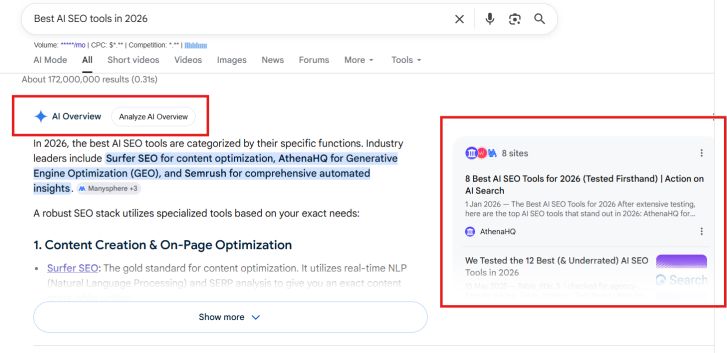
Google AI Overviews (AIOs) are AI-generated responses or answers that appear above traditional organic listings.
The Google Gemini model extracts answers from different web sources and gives credit to those sources with citation links.
For example, let say I search for ‘What are the best SEO tools in 2026?’ ‘
In SEO, it is called “keywords,” and for AI, it’s called “prompts.”
Google will extract the answer from multiple websites, choose the most related and well-structured content, then summarize it and give it as a response or answer to the search queries.
What Are Google AI Overviews?
Google AI Overviews are AI-generated summaries that appear at the top of some search results.
Unlike traditional SEO, where it shows you only blue links, Google now extract answers by combining information from multiple sources across the web.
These AI summaries may include:
- definitions,
- cited websites,
- product recommendations,
- step-by-step explanations,
- comparisons,
- and follow-up questions.
In some cases, users can get answers without even clicking through to any website.
That’s why AI overviews create more concerns for publishers, as clicks decrease significantly and offer opportunities for users.
If your content gets mentioned and summarized, your brand visibility will increase dramatically.
This can also change traffic patterns when Google answers the query without needing clicks.
Why this is very crucial, more than most people realize.
According to the BrightEdge data, AI Overviews now appear in 46% of all tracked queries, up from 31% from the previous year.
The difference in numbers comes from keyword sets and strategies, but the changes are clear: AIOs are getting more awareness and expanding fast.
Here’s is the part that most SEOs, even professionals, are still underestimating.
According to the Seer Interactive study, brands cited in AI Overviews get 15% more organic clicks than uncited brands with the same queries.
However, data shows that traditional organic CTR for queries with AI Overviews dropped or decreased by 61%, from 1.76% to 0.61%.
Take note of this. Being cited as a source in an AI overview not only gives you a mention, but it also sends you more clicks to your brand.
But if your brand disappears from AI visibility and is not cited, you only get a fraction of the clicks, even if you’re on the first page of Google.
This shows that AI Overview is the new front page.
The AI Citation Reality: What Google Uses as Sources.
Before getting to the strategies, you need to understand how Google chooses sources for AI Overviews.
Many SEO and GEO advice even skip this part and just jump directly to ‘add FAQ schema to a blog post and AI will cite it’—which is incomplete.
The truth is that most cited pages by LLMs already rank in the top 10.
One of the best SEO tools, Ahrefs, found that 76% of AIO citations came from pages already ranked in Google’s top 10 and the organic ranking of 1 to 3 positions for cited URLs.
This shows that traditional SEO is still the key factor and the foundation to determine if your brand will be cited across AI search engines.
But there is a new shift in how Google AI Overview and other LLMs mention and cite pages.
Research shows that ranking alone isn’t enough anymore to get cited.
It shows that citation overlap with the organic top 10 is affecting AI Overviews and how they mention and cite pages.
It falls from around 76% in 2025 to 45% in early 2026.
What it tells us is that Google is now pulling from many more pages.
With this new shift in 2026, pages ranking 11 to 20 and even lower are getting cited or referenced if the content is well structured, authoritative, and gives accurate and direct answers to what AIO needs.
In practice, you don’t have to be on page one, but you need to be citable.
What Are the Strategies That Actually Help Your Brand Be Mentioned and Cited?
How to Improve Visibility in Google AI Overviews
Here I’m going to share some strategies that can improve your brand visibility in Google AI Overviews.
Create content that is directly answering questions.
This is my number one trick that helps my website get more AI visibility, mostly on Google and other AI search platforms.
Many SEOs’ content buries the answer. The introduction reaches 300 words before getting to the points.
That’s the main problem for AI overviews when trying to extract a citable answer.
Google’s AI scans for content that directly answers the queries in the first paragraph or in a clearly defined summary section.
The AI platform has no patience to scan long content before extracting and summarizing their response.
Here is my trick that works.
Let your introduction start with an answer, then expand. If your article is about what SEO means, say what SEO means in the first 2 to 3 sentences.
Then, explain in detail and go deeper.
Use a clear heading such as H2 and H3 that mirrors how the user would ask a question.
For example, my experience with SEMrush One doesn’t cut it.
Instead, Does SEMrush One Track AI Visibility?
It is crucial to structure your headings as questions or direct answers, making it easier for Google’s AI to extract its answer from your content. And reference it as a source.
Build topical authority pages, not just individual posts.
If you want to stand out and get your pages cited, you need to build topical authority.
I experimented with it and it worked for me. Most of my pages that get cited are not stand alone. They link to related content, and that content also links back.
This builds a topic cluster rather than individual pages.
You remember that internal linking is one of the Google factors to rank your page, and my results prove it.
And this is correlated with what the data shows. Google evaluates how a topic is covered across a website to decide whether to include it in AI Overviews.
For example, a single post on SEO optimization is less authoritative compared to four interconnected posts that cover the topic from several different angles: what it is, how to get started, which software helps, and what mistakes to avoid.
For a blogger, content creator, and small business, this is an opportunity.
You don’t need to write thousands of pieces of content. You need a deep coverage of your specific niche or market.
A cluster of 7 to 10 interlinked posts on a single topic will perform better than 40 unconnected posts spread across different topics.
If you’re in GEO or AI marketing, your pillar content might be AI SEO with supporting posts on how to rank in AI overview, GEO optimization tools, AI visibility tracking, and AI automation tools.
Each post feeds the other, and together, they send a signal to Google that your site is an authority on this specific topic or industry.
This builds contextual trust.
With what I observe in AI overviews, contextual trust is becoming a major visibility signal in AI search.
The sites dominating AI-related SERPs right now publish clusters, not isolated articles.
The lesson I learned is that AI search engines tend to reward broader topical expertise.
And Google continues to have confidence in a site that consistently demonstrates expertise on this subject.
Structure Your Content for AI to Understand
You know that Google’s AI doesn’t waste time scanning; it looks for extractable content to summarize.
This means that content that has a clear structure, short and easy-to-extract answers, and formatting that help AI understand what content is all about and its relevancy win.
Here is how to format your content for AIO citation.
Here’s the type of content structure that wins:
- Use Strong Heading Hierarchy:
- H1 for the main topic,
- H2s for major sub-topic,
- H3s for supporting explanations.
- paragraphs.Direct Definitions: Clearly explain concepts in the first two paragraphs.
Concise Paragraphs: Use short and concise paragraphs to prevent walls of text, which reduce readability for both users and AI systems.
Add Lists and Bullet Points: AI systems often extract lists into summaries.
Demonstrate Real Experience Matters
This is where you need to apply Google E.E.A.T. and put it into practice, not just a theory.
We’ll know about Google’s helpful content update, which affects 70% of websites, when it was launched a few years ago.
This is where you need to take it seriously. Google rewards content created from firsthand experience, and if you want to rank on search engines and also get referenced by AI models, you need to demonstrate it in your content.
For AI Overviews, it’s very crucial because Google only looks for reliable sources, and regurgitated content is much less likely to be cited.
In my Semrush review, I shared my site audit dashboard screenshot, the specific features I use, and results from my tracking.
And for my best SEO software post, I referenced posts on my blog that were actually being cited and what really changed in my organic traffic.
That differentiates a citable source from just a generic content summary.
For content writers and small businesses, this is your biggest advantage. You can write based on your experience in such a way that a content farm won’t be able to replicate.
Lean on your results, your clients’ results, and what you observe during your experiment.
For SEO professionals and practitioners: Include data from your own research, findings, and tracking.
It may be a client’s case study, as the real number increases your credibility far better than generic advice.
Track Your AIO Visibility
Measuring your AIO visibility requires a different approach compared to the traditional rank tracking.
Here is a simple way to track your AIO visibility.
Semrush One: The Semrush One AI visibility toolkit shows which of your keywords are triggering AI Overviews and which pages are being cited. This is an easy way to monitor and scale, so I check this once a week.
Use Ubersuggest: Ubersuggest is another favorite SEO tool for identifying which of your target keywords trigger AIOs, so you can check content that has citation potential and make any changes for better results.
Manual Checks: I manually check some of my target keywords in Bing to note where my site appears as a source.
This identifies things that the tools miss, especially for longer conversation queries.
Google Search Console: Starting from June 2025, GSC includes AIO impressions data under the Web Search Type.
But the problem is that it doesn’t separate AIO impressions clearly to be able to track.
You can create a document and report on which posts are being cited and which queries trigger AIOs in your niche to know if your citation frequency is growing or decreasing.
This will show you direction and data to adjust and make necessary changes to improve your AI visibility.
Build Authority Off-Page, Not Only On-Page
SE The ranking study of 2.3 million pages surprises me. Domain traffic is the #1 factor of AI citation. High-traffic websites get 3x more AI citations than low-traffic ones.
That’s shows clearly that the more your site is trusted and visited, the more likely Google AI is to extract from it.
And the more you’re referenced in AIOs, the more visibility and clicks to gain.
How to practically archive this:
Build more backlinks from reputable sources in your niche.
A mention from a high-authority site like the Semrush blog, Backlinko, Search Engine Land, or an industry newsletter can increase the credibility of your site.
It builds domain authority and signals to Google that your website is trusted by other reputable brands in the space.
Get your content cited on reputable platform such as Reddit threads, Quora, YouTube, niche forums, podcasts, newsletters, etc.
Google and other AI platforms heavily cite websites like Reddit and YouTube because they have authority and real user engagement.
You can be part of these conversations when you contribute to the platforms to position your content for citation.
Build Your Brand Presence: A brand that gets mentioned across several contexts, such as blogs, social media, forums, and newsletters, builds entity authority.
Google’s AI is likely to cite a source it sees as an established entity in a topic area.
What to Avoid
There are a few things that won’t help, and many often recommend it.
Don’t run after schema markup. FAQ schema and HowTo schema can help Google understand your content structure, but it has started that no special optimization is required to appear in AIOs.
Yes, I understand that Schema helps, but only if the content is strong, but may not have any impact on thin content.
Don’t optimize for AI overviews to dilute the quality of the content.
Some content reads like a robot wrote it after being restructured for AI overviews. This will work against you.
The goal is to write content that is genuinely useful for humans and structured clearly for AI to extract.
Traditional SEO Is Still The Key: Don’t Ignore It
Data shows that 76% of AIO citations is from top 10 ranking pages. The SEO foundation is still the key to getting cited.
The Google ranking factors—internal linking, mobile experience, page speed, and on-page SEO—can’t become irrelevant because of AI Overviews are in play.
The Truth About AIO Visibility
One thing I want you to know is that AIO visibility is not fully within your control.
Google makes its decision on what to cite, which involves factors such as the query context, the device, and the user’s locations—these are significantly varied.
You can read about what Google says on optimizing websites for generative AI for better understanding.
What is in your control is your content.
You can decide whether your content is the type of content Google can cite.
You can structure your content clearly for AI to extract. Make it authoritative enough to trust. Create content that covers a topic deeply enough to be considered a source.
That’s the exact framework to follow.
This same framework will build organic visibility with the clear structure, depth, and demonstration or firsthand experience.
I’m paying more attention to this on HubDip and my other site and have seen my AIO citations grow.
This has not happened instantly and not on every post. But on the posts that follow the guidelines above.
That’s what keeps me building in this direction, and you can do the same.
Final Thoughts on Visibility on Google AI Overviews
Improving visibility in Google AI Overviews is no longer about chasing SEO ticks.
You just need to understand how search is changing.
Google’s AI system was trained to prioritize the following:
- Useful answers
- Contextual expertise
- Clear communication
- Trustworthiness
The sites that are likely to win are the ones that become a reliable source, not simply an optimized page.
The web doesn’t need another 20,000 rewritten articles repeating the same thing.
Readers want genuinely useful perspectives backed by real data, experience, insight, and expertise.
That’s what AI systems prefer to reward.
And I’m confident that this is where SEO is heading to.
Google AI Overviews Action Checklist
Indemnity: Which of your target keywords already trigger AI Overviews. Use Semrush One, Ubersuggest, or do it manually.
Audit your top 5 to 10 posts and see if they answer the query directly in the first paragraph.
Build at least one topic cluster with 6 to 10 interlinked posts.
Add a well-structured FAQ section to your posts.
Track your AIO Overviews such as citation, queries, and CTR trends.
Check your Google Search Console for queries with high impressions but low CTR. You can identify AIO interception points.
Create an account on the Bing search engine and add your website. Bing has introduced AI visibility sections where you can see queries or keywords that are triggering citations and clicks.
Start getting brand mentions on high-authority websites in your niche to build your site authority and trustworthiness.
Do you have a post that has been cited in Google AI Overviews? I would like to know your strategies if different from what I shared.
You can read my post on how to improve brand visibility. in AI search engines. You can check the best AI SEO tools to optimize your content for better ranking.
Other SEO tools you may want to check to improve your SEO experience.
Semrush Guru: The best Semrush plan for agencies and SEO teams.
Keysearch keyword tool: best alternative to Semrush SEO software
Related Posts
Best AI SEO Plugin (2026): Optimize For AI Search
.
